Grief is a funny peculiar thing. It creeps up on you when you expect it to confront you head on. When I lost a loved one in the Spring, I spent the Summer believing that dysfunctional behavious were justified by circumstances, not connecting the anguish to the death, which I thought I was coping with.
The root problem is not being able to let the relationship go. They may not be in your daily life, but they should be. The relationship is continuing in their physical absence and something – anything – has to make-do as their stand-in. It could be something sensible, like lighting a candle, or something unhinged like developing a persistant cold.
I have a friend who talks to her Dad’s picture, and another who contacts their mother through the tarot cards. More people feel close to their loved one as they tend their gravestone, or pray for them during a religious service, or visit them at their favourite park bench.
I wanted to cling on to the funeral like Miss Havisham, clinging to her cancelled wedding. I didn’t want life to continue, until I was a week away, a year away, a decade away, barely able to remember what it was like to have them around. My new normal, set in habits and routines, that they didn’t see, and memories that they didn’t share.
Although I wasn’t alone, it made me think of all the washed-up women who rattled around small houses or flats after their glory years were done. Maria Callas pacing the floor in Paris, Capucine leaping from her window in Lousanne, Little Edie still doing nothing in Miami.
A long decay into death is the most dramatic thing that can happen to a person and it’s rarely dramatised, the more optimistic fantasy of dying, young and loved, being more pleasing, not just because the young are attractive, but because it didn’t get them anything. No need to be jealous. They’re as dead as we’ll be.
So, after a brief pang about not being in one of those zesty couples in the 1950s, forever starting out in life, tarting up their tatty new place, amid the cheery chaos of their newbie careers – I was floating downstream with the cursed Lady of Shallot, dashed on the rocks with Hero after the agony of seeing Leander’s drowned body, and running across the moors to claw at Heathcliff’s window with Cathy.
Until it seemed absurd.
There’s only so much heroic passion it’s possible to distract your mind with when you’re avoiding answering emails and taking the bus from a suburban house to a freezing cold office. Eventually I’m left with glum persistent reality. They’re not in the record shop looking for folk singers. They’re not in the clothes department misremembering their waist size. They’re not in the coffee franchise stirring sugar into their Americano.
We’re not going to discuss holiday destinations, denounce politicians or not recognise the influencer on a reality show.
They won’t change the oil in their car, slip on the ice, forget their hat on the hottest day of the year.
No more Hunter’s Moon. No more Birthdays. No more New Years.
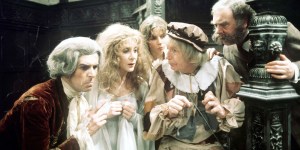
This Christmas is the first without them. All the sparkle of December is dreich. Except for one odd, saving grace, a tiny path through the woods, found in a slow-paced children’s sitcom from the 1970s. The Ghosts of Motley Hall.
Set in an empty stately home, it features the gentle antics of five ghosts and a caretaker.
Comedian Arthur English, plays Bodkin, a nostalgic Elizabethan fool, who died in a pond, plays wistful tunes on his recorder and says Gloriana whenever he’s shocked or surprised. English isn’t afraid of a pause, or to hold a bewildered smile, or to whisper. His performance accumulates in these gaps until he’s an old friend.
Freddie Jones, is fantastically funny as the blustering Victorian, Sir George Upshot, a disasterous General who died falling down Motley’s sturdy staircase. Treating the other ghosts as his regiment, he yells forward whenever there’s a crisis or a consultation. Jones’s gestures of precarious pride and erupting rage are so detailed that he would win awards if he was anywhere other than tea time telly.
Sean Flanagan plays, Matt, an unsickly sweet stable lad, who, unlike the other housebound inhabitants, can roam the grounds of Motley, as well as the Hall. Flanagan is the idealistic moral centre of the show, swashing with very little to buckle, all pipsqueaking inocence with an hint of hearty no good, wide-eyed, buck-toothed, floppy haired, scoffing and delighed. Off-screen his life was tragically short, dying in a motorbike accident on the 27th of June 1981, at the age of just 23.
Nicholas Le Prevost is the lovable Regency rake, Sir Francis ‘Fanny’ Upshot, who died in a duel, drinks too much, can’t even remember the bawdy lyrics of his party piece, and combines a soft, clumsy, heart with a streak of haughty pugnacity. His life of depravity has left barely a mark on his simple soul. He will mutter his way out of anything that seems too nasty.
Which leaves my new style icon and life goals – Sheila Steafel – a comic marvel – who, in 2010, admited to having fallen out of the public eye, and being reduced to using her ex-husband’s name in the title of her autobiography, as a sales ruse. A bizarre injustice. Her White Lady is winsome, and loutish, as she wails, groans, moans, sighs, sobs and whines on the staircase, in the basement, and in the belltower of Motley. She can’t remember who she is, and after an ecounter with normality, decides she doesn’t want to.
Her relationship with the caretaker, Gudgin, played by Peter Sallis, is beautifully written. From her perspective she’s requesting assistance or helping him, from his perspective he’s being tormented by strange voices and mad gestures.
Their uncanniness can be a metaphor for anyone who is a misfit in life, as well as solace for the finality of death. Our time will pass. Even if we never leave home, never redecorate, keep the same habits, have the same friends we will still end up as dead and outdated as Ancient Greece. The roof will fall in. The plaster will peel. The path will overgrow. Final breaths will be taken. All this life was here, and then it’s not.
Although, somehow, curled up for five nights in a row, with a mug of hot chocolate, watching an old show about ghosts, helped me to accept that I would always think of my loved one, always see them out of the corner of my eye, or dream they’re still with me, and although it’s not what I want, they could be on the other side, squabbling and plotting, part of this time and place, loved and yearning, frantically waving their sleeves in my direction.

 Kay Marquis