Draclua, Mina’s Reckoning, National Theatre of Scotland, Theatre Royal, Glasgow, 16 September 2023
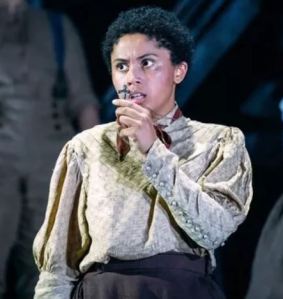
My mother loved this show and got slightly squiffy on two bottles of prosecco. I had the beginnings of bronchitis and was trying not to cough. Behind me a teenage boy was explaining vampire lore to his mother. And beside me a woman started crying because the show was set in a lunatic asylum and she felt sorry for the women.
t wasn’t scary – but Dracula never is – at one point it may have filled people with dread for their immortal soul – but I doubt it. Dracula is too much of an old ham. Written with Bram Stoker’s boss, the actor-manager, Henry Irving in mind – it’s a verbose melodrama, vastly improved by Morna Pearson’s feminist focus, where the women in an asylum act out the story, from Jonathan Harker’s trip to Transylvania, played with earnest vulnerability, by Catriona Faint, to a new ending that makes it more of a superhero origin story than a Gothic horror.
If Bram wrote the novel while feeling limited by his boss and his wife, it makes sense to transfer that feeling of limitation to the social mores and laws of 1890, that severely restricted all women’s lives. There are some funny lines about books making ovaries shrink, and Maggie Bain is swaggeringly attractive as Dr. Seward, a male chauvinist pig. You can imagine why the sweet Lucy (Ailsa Davidson), destined to be made undead, was impressed enough to get engaged to him, and why the resolute Mina (Danielle Jam), her bestfriend, the tale’s new protagonist, was so affronted by it. The scenes where they are brightly exploring the beach, contrast with the bloody and chilling end that Lucy will come to.
That end comes at the fangs of Liz Kettle, who plays Dracula as a pantomime villian on a fag break, dishing out advice to her prey before getting back to the business of drinking their blood. It’s a fabulously wry performance. The bit where she moved around in the dark, with a tiny boat, to represent his stormy voyage to – in this version – North East Scotland – was almost ridiculous, but was saved by a slow spooky charm.
Renfield (Ros Watt) – the fly eating mental patient in telepathic communication with Dracula – has never been more sympathetic. A ‘woman who wouldn’t be told’ – imprisoned to make them conform, both endearing and disgusting. The gibbering fear of madness in most adaptations, is here replaced by the pathos of a mistreated misfit. You wonder what they could have been, if they had been allowed. The nastiness of their food chain project, geting a spider to eat a fly, a bird to eat a spider, a cat to eat a bird, because ‘the blood is the life‘, has a beauty to it, when thought of as the only way their spirit could survive in the crushing conditions they were forced to live in.
Anne Lacey, is magnificent as the drunken sailor, Mr Swails, and the old sloven, Bella; while Natalie Arle-Toyne, quietly steals every scene she’s in as Van Helsing.
It’s written in mild Doric – fit for what, ken for know, quine for women (a word I have never heard in the wild) – so in the interval someone joked it could be called Scotula; and, probably in reference to the brilliant all female and non-binary cast, her friend came back with Wokeula. Despite the puns, they thought it was one of the best things they had ever seen.
One intensely obnoxious man behind me, in the far too long queue for the bar, said – very loudly – that he found some scenes so embarrassing that he had to close his eyes.
I’d take that as a compliment.
 Kay Marquis